
Every year, as I stand before the façade of ARTJOG, I witness the same small “ritual” unfold. Visitors line up with patience and excitement, waiting for their turn to pose beneath the large white letters spelling “ARTJOG.” Some smile, some turn their backs to the camera, while others perform playful gestures. It is as though one’s presence at this festival only becomes “real” after being photographed. Over time, this act has become a photographic practice that defines how people experience and remember ARTJOG.

For me, this repeated act embodies the spirit of amalan, the year’s curatorial theme: practice as a form of devotion, a continuous doing that binds art and life. Through these practices that I observed, the visitors themselves extend the exhibition’s life into digital space.
Observing the Image-Makers
When I began my ethnographic research at ARTJOG 2025, I imagined the pleasure of visitors who come into this exhibition space, reading every caption presented without being distracted to look for other works besides the enjoyment of “entering” each artwork presented from room to room. The act of photographic production seems to still be carried out by the visitors; they are not hesitant to pose in front of the artworks according to the discussion of the work, without making any effort to exclude other works that might appear in the photo they take. From this massive photographic production, I become curious about where these created photos will eventually go.


In this curiosity, I try to observe several movements of ARTJOG visitors both inside the exhibition space and on social media through what they share on their personal accounts. The starting point of this observation was when I was inside the exhibition space, watching how each visitor looked and how they gestured when facing an artwork.
Firstly, I observed how visitors who came to enjoy the works would appear firm and serious, seen reading the captions of the works presented, going back and forth between reading the caption and observing the exhibited work. After finishing reading the artwork caption, the visitors would move on to look at the work more firmly. I rarely saw them taking photos in front of these works; they only occasionally photographed the work and its caption. However, in this short observation, I found only a few visitors of this kind inside the exhibition space.
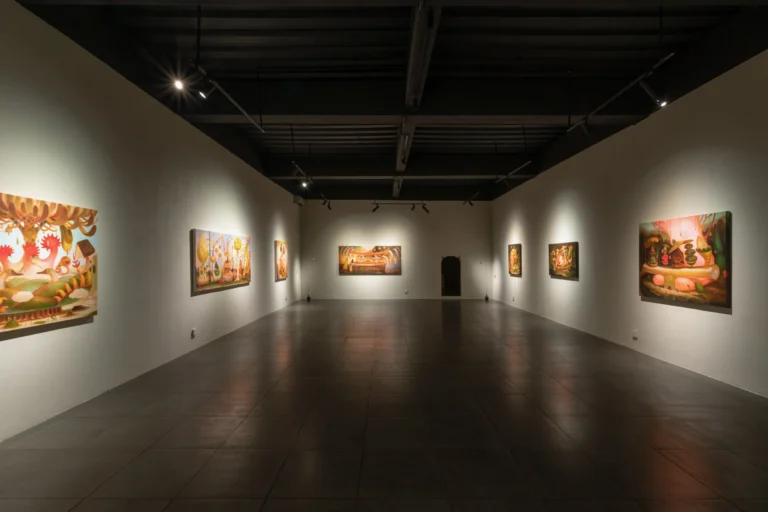
Secondly, I observed visitors who came to find “epic” works to fulfil the needs of their photographic practice. From my observation, these visitors did not really look at the captions, only glancing briefly during their walk through the exhibition. The exhibited works were also not fully viewed; these visitors did not spend much time in rooms they considered less interesting and did not take photos there. It was different when they entered a space they found visually attractive or suitable as an object to take photos in front of. These visitors would stay longer in this room. If they came alone, they would ask the gallery sitters to take their photos in front of the work; they posed in front of the artwork. If they came in groups, they would take turns taking photos of each other.
From what I observed, the most common pose was turning their back towards the camera, as if deeply focused on looking at the work. The second was, when in a bright exhibition space, they would smile widely in front of or beside the artwork; and in dimly lit spaces, they would pose plainly without smiling. Among the works I observed, those with bright lighting, mirrors, or chairs were the most frequently used as backgrounds for photos.
The Circulation of Presence
From this observation, I became curious about how the photos taken here were distributed, in a sense of where and in what form these images would circulate. Then I started to look at how photos and videos were shared on Instagram and TikTok, searching through hashtags #artjog2025 and “ARTJOG2025”. There were more than 1000 posts on Instagram and TikTok, and on Instagram, I found various poses that matched what I had observed. This search seemed to reaffirm what I had seen directly in the exhibition space.
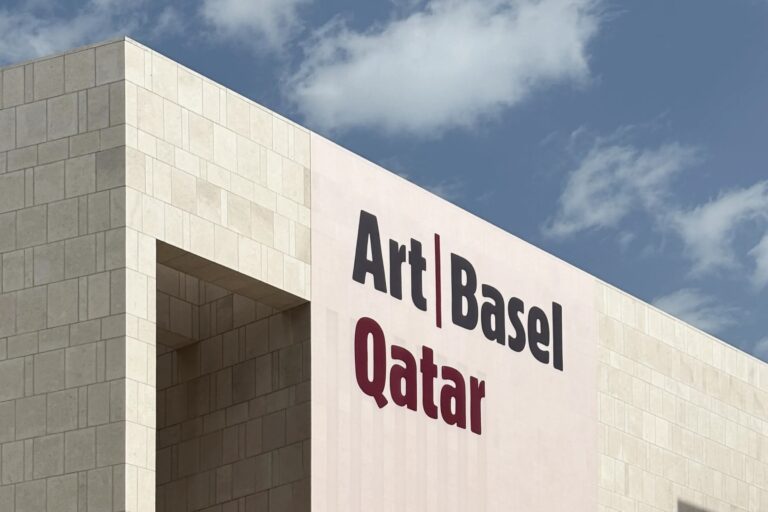
In the various photos and poses shared on social media, most accounts featured photos of themselves in front of the facade with the word “ARTJOG” as the opening slide of the next images. The white letters “ARTJOG” against the large maroon wall background seemed to emphasise what the posters wanted to say. An existential assertion that they were truly present at the exhibition.


For me, this photographic event confirms that such practice needs to be read (how it weaves the relationship between artist, ARTJOG, and visitor). The artists present their works to be “pleasant” to see and to photograph, according to the concepts they discuss. Meanwhile, the ARTJOG organisers arrange each artist’s work in a space that invites the audience to focus on viewing each work one by one. The visitors, in turn, seem to select and choose which artworks they wish to produce as content to be shared.
For me, visitors have a very important role. They seem to be the main actors in this space. They willingly come into this exhibition, pay the ticket price, and agree to obey all the rules set by ARTJOG during their visit. Unfortunately, visitors are not truly acknowledged within the broader circle of the visual arts; they seem to be left as they are, seen merely as numbers of daily attendance.
The Movement of Visitors
It is a different matter when observing the movement of visitors inside ARTJOG. For me, visitors no longer interpret what is inside the gallery by distinguishing between high art and low art. Everything is presented as a unity without boundaries. The photos taken by visitors inside the exhibition and shared on social media show that they truly celebrate what is happening today.
It cannot be denied that the works presented by the artists are the result of deep thinking filled with essential meaning. Yet for me, in today’s development, an art exhibition has become a recreational arena. The visitors who come are no longer here to read and understand in depth the concepts explained by the artists. Even if they read them carefully, this experience would likely fade soon after finishing the exhibition visit. Today, art exhibitions, especially ARTJOG, have become a kind of recreational venue for holiday visitors.


I imagine, when seeing visitors queueing in front of the façade, taking turns to take photos, that they are like tourists visiting a historical site or a city landmark. This event resembles tourists visiting Malioboro Street in Yogyakarta, where many people are willing to queue and wait just to take pictures with the street sign that reads “JL. MALIOBORO”. The ARTJOG sign on the façade seems similar to that Malioboro street sign, sharing a likeness as an iconic form that marks the actuality of the visitors’ presence.
The Exhibition as Arena
Photography was not only performed by visitors; it was also presented within the artworks. On the second floor, Beawiharta, a senior photojournalist, presented four monumental diptychs that match his earlier documentary images with more recent re-photographs. One pair showed the iconic Indiana Jones Bridge (2012) depicted schoolchildren crossing a fragile bridge in Lebak, West Java, alongside a portrait of Aan Rosidah, one of the children, now grown and holding her own child.

Another diptych revisited the 2004 Aceh tsunami, pairing a haunting scene of refugees with a serene image of Sabariah and her son Fastabiqul twenty years later. Each work was printed on a monumental scale, accompanied by precise captions that anchored the images in real time. Standing before these photographs, I felt the gravity of long-term seeing. Beawiharta’s practice was not about capturing a moment but about returning to it. To people, to places, to histories that refuse closure. His persistence over decades exemplified amalan as a sustained relationship between photographer, subject, and time. In this way, his work mirrored the visitors’ own photographic practices.
Reflecting on these overlapping practices, I was again reminded of Sanento Yuliman’s essay “Two Visual Arts” (1984), which questioned the binary between “high” and “low” art. For Sanento, Indonesian art existed within social strata, between the elite artworld shaped by Western modernism and the creativity of local communities practised everyday. At ARTJOG, these divisions seem to dissolve. The acts of photographing, posing, and sharing reveal an art space that no longer distinguishes between aesthetic contemplation and social enjoyment. The exhibition becomes an arena, where professional artists, casual visitors, and digital audiences coexist.
Even the artworks themselves play with this openness. On the first floor, Surya Adiwijaya’s installation of blacksmith tools sits beside Veronica Liana’s sculptures made from domestic objects. One recalls the disappearing tradition of manual labour, while the other celebrates the repetitive gestures of motherhood. Both works elevate the ordinary into the aesthetic, echoing the same inclusivity that visitors express through their photos. In this sense, ARTJOG operates as a living laboratory of Sanento’s vision, a space where art is no longer divided by class or form, but bound by practice and participation.
Photography as Social Practice
To photograph at ARTJOG is to engage in an act of social negotiation. The visitor’s camera does not only point outward; it also reaffirms belonging. Yet I also noticed that visitors, despite being central to this ecology, are rarely acknowledged within the art discourse. Their contributions are often reduced to numbers (ticket counts, attendance, social media engagement). But speaking about it, they are the co-creators of the event’s meaning. Without their eyes and devices, ARTJOG would remain a static structure. Their images “animate” the exhibition, turning observation into participation. If we understand amalan as the practice of goodness of doing and giving, then these photographic acts become micro-practices of care. They express affection toward the artworks, the festival, and the community that gathers around it.


As the exhibition will return next year, I turned back to the maroon façade. In that instant, I realised I too was part of the same cycle. Another participant practiced the image. My photograph, like theirs, was a small devotion to this place and its spirit. ARTJOG had taught me that in art, as in life, to look is also to give.